What Is Liquidity in Trading?
Liquidity in trading is how easily and quickly an asset can be bought or sold without causing a significant change in its price. A highly liquid market has many active buyers and sellers, tight spreads, and fast execution, while an illiquid market has few participants, wider spreads, and more slippage.
Liquidity describes the trade-off between speed and price: in a liquid market you can transact a large size almost instantly at a price close to the last quote, whereas in an illiquid market getting filled quickly forces you to accept a worse price. Note that this article focuses on market liquidity (how tradable an asset is), which is different from accounting or financial liquidity, which measures a company's or individual's ability to meet short-term cash obligations.
How liquidity is measured
No single number defines liquidity. Traders read it from several complementary signals, and the strongest read comes when they agree.
- Bid-ask spread: the gap between the best buy and sell price. Tighter spreads generally mean more liquidity and lower transaction costs.
- Trading volume: how much of the asset changes hands over a period. Higher volume usually signals more activity, but it is only one input.
- Market depth (order book): how many resting orders sit at each price. A deep book absorbs large orders with little price impact.
- Execution speed: how fast an order fills at or near the expected price. Slow fills and large gaps point to thin liquidity.
A common pitfall is assuming high volume always equals high liquidity. During a crash, volume can spike while real liquidity dries up, so spreads widen and fills get worse precisely when participants most want out. Volume and liquidity are related, but they are not the same thing.
High-liquidity vs low-liquidity markets
Forex is the most liquid market in the world, with global daily turnover of roughly $9.5 trillion as of the BIS Triennial Survey (April 2025). Major currency pairs, large-cap stocks such as AAPL, NVDA, or TSLA, and major index ETFs are also highly liquid. At the other end sit penny stocks, exotic currency pairs like USD/TRY, micro-cap stocks, real estate, and collectibles, where few participants mean wider spreads and difficult exits. Liquidity also shifts by time: it is deepest during major sessions, especially the London/New York overlap, and thins out pre-market, after-hours, on holidays, and around major news, which widens spreads and raises gap risk.
Liquidity in Smart Money Concepts
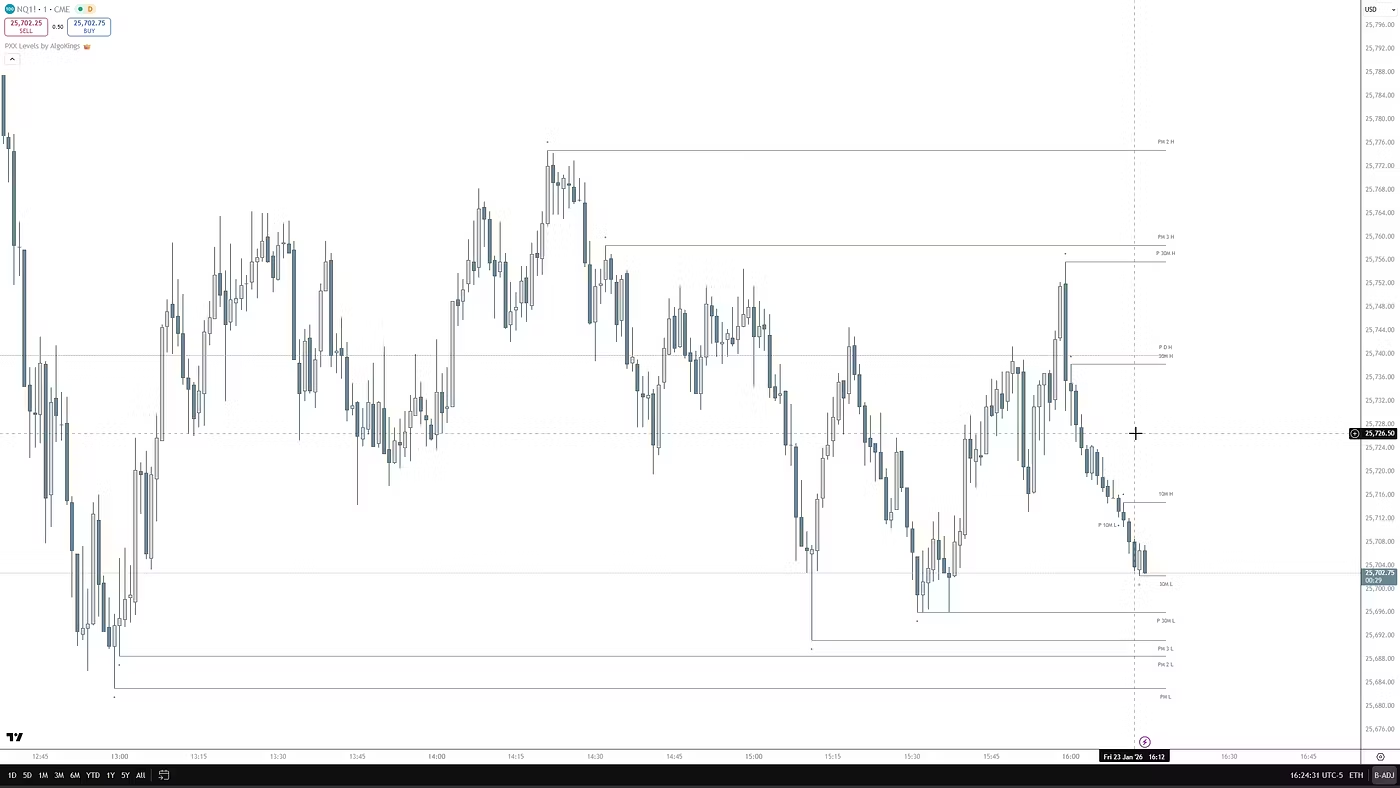
Beyond the classic definition, many traders, especially in Smart Money Concepts (SMC), use liquidity more specifically to mean clusters of resting orders, mostly stop-losses, that pool around obvious levels. These liquidity pools tend to form above swing highs, below swing lows, around equal highs/lows, and at round numbers. A liquidity grab, sweep, or stop hunt happens when price pushes into one of these clusters, triggers the resting stops, and then often reverses. This is not necessarily manipulation in the conspiratorial sense; it is a natural consequence of large orders needing counterparties, and stops conveniently clustering where they are easiest to find. A practical takeaway: placing your stop at the single most obvious spot puts it exactly where liquidity tends to be swept.
Why liquidity matters for your trading
Liquidity directly affects cost, risk, and execution quality. Liquid instruments give you tighter spreads, less slippage, and easier entries and exits; illiquid ones can trap you in a position or fill you far from your intended price. Two risk-aware habits help: check the spread, volume, and book depth before you trade an unfamiliar instrument, and factor liquidity into position sizing, because a large order in a thin market moves price against you (market impact). Remember too that liquidity can evaporate fast during flash crashes or extreme volatility, so even a normally liquid asset is not guaranteed to be easy to exit. None of this is investment advice; it is context for managing your own risk.
Frequently asked questions
What is liquidity in trading in simple terms?
It is how easily you can buy or sell an asset quickly without moving its price much. Liquid markets have many buyers and sellers, tight spreads, and fast fills; illiquid markets have few participants, wider spreads, and more slippage.
What is the difference between liquidity and volume?
Volume is how much of an asset trades over a period and is one signal of liquidity. Liquidity is the broader ability to transact without moving price, which also depends on tight spreads and deep order-book depth. High volume during a crash can coincide with poor liquidity.
What is a liquidity grab or stop hunt?
It is when price pushes into a cluster of resting stop-loss orders, often just beyond swing highs/lows, equal highs/lows, or round numbers, triggers those stops, and frequently reverses afterward. It reflects large orders seeking counterparties at obvious levels, not necessarily deliberate manipulation.
Risk disclosure
AlgoKings provides technical analysis indicators and educational material for informational purposes only. Nothing on this website is financial, investment or trading advice. Trading financial instruments carries a high level of risk and may not be suitable for every investor; you can lose some or all of your capital. Indicators do not predict future price movements and do not guarantee any outcome. You are solely responsible for your own trading decisions and risk management. Past performance is not indicative of future results.