The Power of Three (PO3) Explained
The Power of Three (PO3) is a price-action framework, popularized by Michael J. Huddleston (the Inner Circle Trader, ICT), that describes how a candle or trading period forms in three sequential phases: Accumulation, Manipulation, and Distribution. It is also called the AMD model, and it is an interpretive way to read liquidity and market structure, not a mechanical buy/sell signal.
What PO3 (Accumulation, Manipulation, Distribution) actually describes
PO3, or the AMD model, breaks a trading period into three phases. In Accumulation, price consolidates in a tight range (often during the Asian session) while positions are built. In Manipulation, price makes a false move against the expected direction, sweeping liquidity above a recent high or below a recent low to trip stop orders. ICT calls this the 'Judas Swing'. In Distribution, price reverses and delivers the larger, expansive move in the intended direction. The opening price, commonly the New York midnight open at 00:00 ET, acts as the reference point you measure these phases against.
How PO3 maps onto a single candle
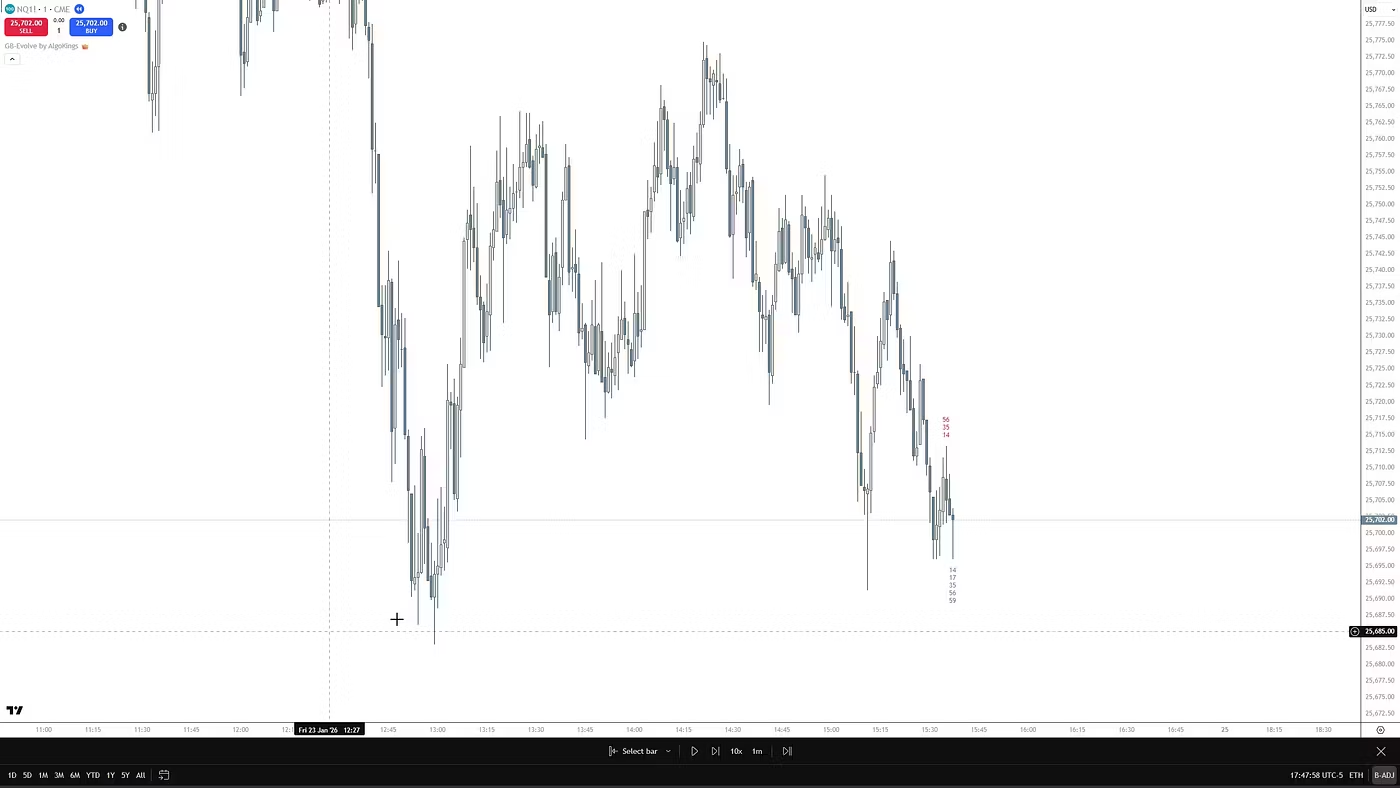
On a daily candle, the model often reads as: price opens, sweeps one side (the wick from the manipulation phase), then reverses and runs toward the close. A bullish daily candle frequently dips below its open to grab sell-side liquidity before expanding up; a bearish candle does the inverse. PO3 is also described as fractal: the same AMD cycle is said to nest across timeframes, so a single daily candle's wick can itself look like a complete AMD cycle on the 15-minute chart. Separately, ICT traders often map the cycle onto the trading day itself — treating the Asian session as accumulation, the London open as manipulation, and the New York session as distribution — which is why session timing features so heavily in this framework.
How traders apply the model
- Establish a directional bias on a higher timeframe (daily or 4H) first. Without a bias, you cannot judge which side the manipulation is sweeping.
- Mark the relevant opening price. Many ICT traders use the New York midnight open (00:00 ET) rather than a broker's local daily open, since the open anchors where the phases are measured from.
- Wait for the manipulation sweep against your bias instead of entering during accumulation, where premature entries get caught in the Judas Swing.
- Look for lower-timeframe confirmation that the sweep has failed, such as a Change of Character (ChoCh) or shift in structure, before considering an entry.
- Define risk beyond the manipulation extreme, since session-open volatility can spike further than expected; stops placed tightly inside the sweep zone are easily taken out.
Honest limits: PO3 is interpretive, not mechanical
PO3 is discretionary. Two traders can label the same chart differently, and a move you read as 'manipulation' can turn out to be a genuine breakout. It conceptually echoes Wyckoff's accumulation and distribution schematics, but the framework is a model of liquidity behavior, not proof that institutions manipulate every candle. Strongly trending days may show little accumulation, and choppy days produce false sweeps, so the edge comes from correct bias and context rather than the pattern alone. Treat PO3 as an analytical lens for understanding structure, and always manage risk on your own terms.
Frequently asked questions
What does PO3 stand for, and is it the same as the AMD model?
PO3 stands for Power of Three, the idea that a candle or period forms in three phases. Yes, it is the same concept as the AMD model: AMD stands for Accumulation, Manipulation, and Distribution, the three phases PO3 describes.
What is the Judas Swing in PO3?
The Judas Swing is ICT's name for the manipulation phase: a deliberate false move against the expected direction that sweeps liquidity above a high or below a low (tripping stops) before price reverses into the real, distributive move.
Does the Power of Three only apply to the daily candle?
No. PO3 is described as fractal, so the same Accumulation-Manipulation-Distribution cycle is said to appear on weekly and daily candles and inside lower timeframes simultaneously. A daily candle's wick can look like a full AMD cycle on a 15-minute chart, which is why traders use higher timeframes for bias and lower ones for entries.
Risk disclosure
AlgoKings provides technical analysis indicators and educational material for informational purposes only. Nothing on this website is financial, investment or trading advice. Trading financial instruments carries a high level of risk and may not be suitable for every investor; you can lose some or all of your capital. Indicators do not predict future price movements and do not guarantee any outcome. You are solely responsible for your own trading decisions and risk management. Past performance is not indicative of future results.