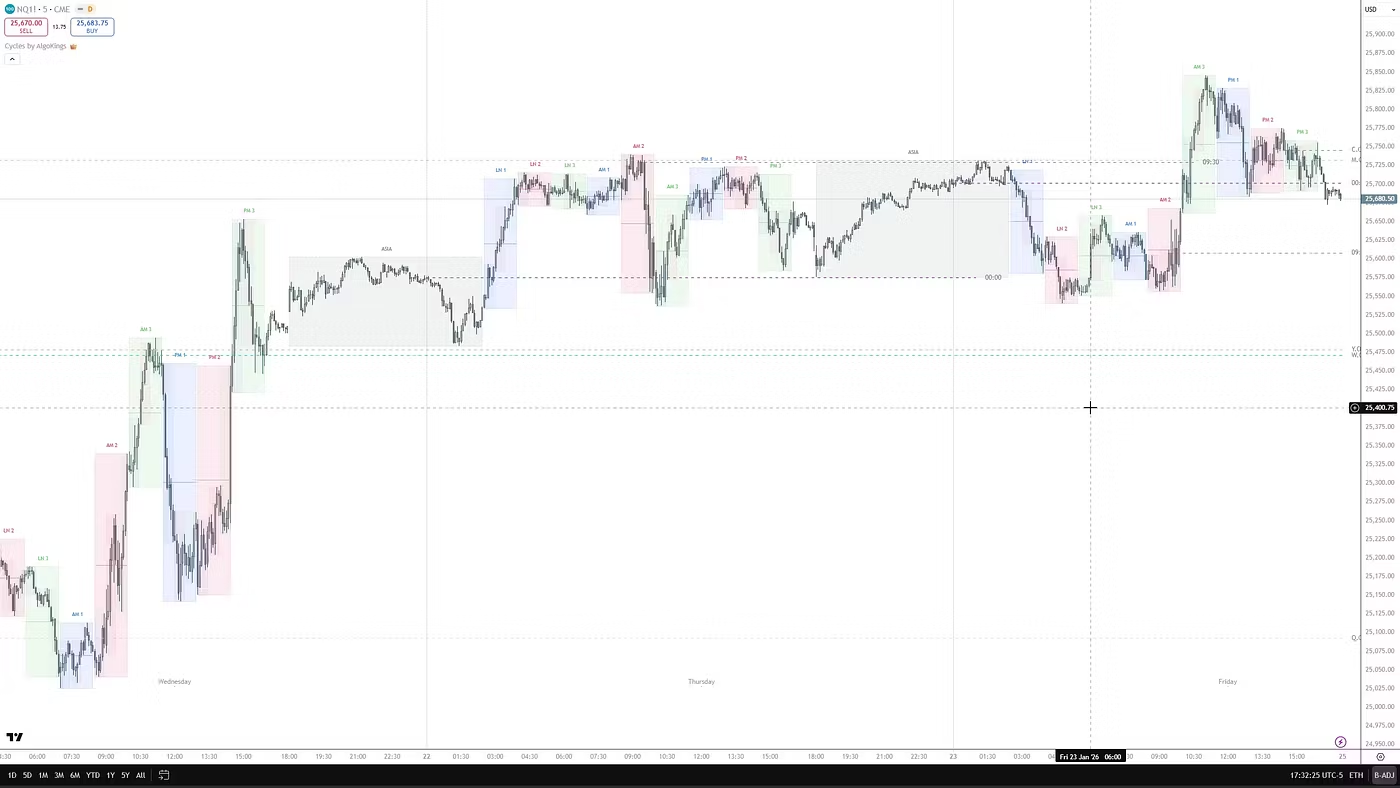
Position Sizing in Trading Explained
Position sizing is the process of deciding how much capital to commit to a single trade — expressed as the number of shares, contracts, lots, or units you buy or sell. The most common approach is risk-based: you risk a small fixed percentage of your account per trade and derive the size from the distance between your entry and your stop-loss.
Why position sizing matters more than your entry
Most traders obsess over entries — the perfect signal, the perfect indicator. But position sizing is what actually controls your drawdowns and determines whether you survive the inevitable losing streaks. By capping the loss on any single trade, sizing is the primary mechanism of risk management. A great entry with reckless sizing still blows up an account; a mediocre entry with disciplined sizing can survive a long run of losses. The math is unforgiving here: a 50% loss requires a 100% gain just to break even, so keeping each loss small is not optional.
The core risk-based formula
The most widely used method is fixed-fractional (percent-risk) sizing. You decide what fraction of your equity you are willing to lose if the trade hits its stop, then back out the size:
Position Size = (Account Equity x Risk %) / (Entry Price − Stop-Loss Price)
Worked example: with a $10,000 account risking 1% per trade, your dollar risk is $100. If your entry is $50 and your stop is $48, the stop distance is $2, so your position size is $100 / $2 = 50 shares. Notice the key relationship — a tighter stop allows a larger position for the same dollar risk, and a wider stop forces a smaller one. As your account grows the dollar risk (and size) scales up; as it shrinks, the size scales down automatically, which is exactly what you want.
How much to risk per trade
The common guideline is 1-2% of equity per trade. Beginners are usually better served starting at 1% or less, and many systematic traders run 0.5% or below to smooth out volatility. The smaller and more consistent your per-trade risk, the more losing trades in a row your account can absorb. Risking 10% per trade means a normal streak of losses can be catastrophic; risking 1% makes the same streak a survivable dip. Whatever number you choose, the discipline is to keep it small and apply it consistently — not to raise it after wins or chase losses.
Methods beyond fixed-fractional
- Fixed dollar / fixed units: always trade the same dollar amount or the same number of shares/lots. Simple, but dollar risk varies wildly trade to trade because it ignores the stop distance.
- Percent-of-equity: size as a fixed percentage of account value. Scales with the account but, on its own, still does not tie size to where your stop sits.
- Fixed-fractional (percent-risk): the formula above — risk a set percentage and derive size from the stop. The standard for most discretionary traders.
- Volatility-based (ATR): use Average True Range to set the stop distance, then size so dollar risk stays constant. Positions shrink automatically when markets get choppy and grow when volatility contracts.
- Kelly Criterion: a formula that targets the growth-maximizing bet size from your win rate and win/loss ratio. Full Kelly produces severe drawdowns and assumes you know your exact edge — so most practitioners use a fractional 'half-Kelly' or 'quarter-Kelly' to tame the swings.
Sizing across markets, and how indicators fit in
The formula stays the same; only the unit changes. Stocks size in shares, forex in lots (with the stop measured in pips and a pip value per lot), futures in contracts (with risk measured in ticks and a tick value), and crypto in coin units or contracts. Leverage and margin do not change your risk math — they let you hold a larger position than your cash, which magnifies losses if you do not reduce your risk percentage accordingly. Practical workflow: define your entry and a sensible stop level first, plug them into a position size calculator (or the formula), and only then enter. Many traders use AlgoKings TradingView indicators to mark structure-based entry and stop-loss levels, which then feed directly into the size calculation.
Common mistakes to avoid
- Confusing position size (total capital deployed) with risk per trade (the amount lost if the stop hits) — they are different numbers linked by the stop distance.
- Risking too much per trade (5-10%), which a normal losing streak can turn into a deep, hard-to-recover drawdown.
- Using a fixed number of shares or a fixed dollar amount without reference to the stop, so real risk varies trade to trade.
- Ignoring volatility, or over-leveraging with margin without lowering the risk percentage.
- Widening or moving a stop after entry to avoid being stopped out — this silently increases your real risk beyond what you sized for.
- Increasing size after wins or revenge-sizing after losses instead of staying consistent.
- Forgetting slippage, gaps and trading costs: price can jump past your stop, so realized risk can exceed the planned amount.
Frequently asked questions
How do I calculate position size using a stop-loss?
Decide your dollar risk first (account equity x risk %, e.g. 1% of $10,000 = $100). Then divide that by the per-unit stop distance (entry price minus stop-loss price). With a $2 stop distance, $100 / $2 = 50 shares. The same logic applies to lots, contracts or coins — only the unit and the per-unit value change.
What is the difference between position size and risk per trade?
Risk per trade is the money you lose if your stop is hit — typically a small fixed percentage of your account. Position size is the total quantity (or capital) you put on. They are linked by the stop distance: a tighter stop lets you hold a larger position for the same risk, while a wider stop requires a smaller one.
Should I use the Kelly Criterion for position sizing?
Kelly mathematically targets the growth-maximizing bet size from your win rate and win/loss ratio, but full Kelly assumes you know your exact edge and produces severe drawdowns when you do not. Most traders who use it apply a fractional half- or quarter-Kelly, and many prefer the simpler, more conservative fixed 1-2% risk rule. None of this is a guarantee of returns — it is a framework for managing risk.
Risk disclosure
AlgoKings provides technical analysis indicators and educational material for informational purposes only. Nothing on this website is financial, investment or trading advice. Trading financial instruments carries a high level of risk and may not be suitable for every investor; you can lose some or all of your capital. Indicators do not predict future price movements and do not guarantee any outcome. You are solely responsible for your own trading decisions and risk management. Past performance is not indicative of future results.