How to Trade Fair Value Gaps (Step by Step)
To trade a fair value gap (FVG), you identify a three-candle price imbalance left by a strong move, wait for price to retrace back into that unmitigated zone in line with your higher-timeframe bias, then enter on confirmation with a stop just beyond the gap and a target at the next logical structure level. This guide walks through each step, including how to draw the gap correctly and where FVGs fail — because they are probabilities for analysis, not buy/sell signals or guaranteed outcomes.
What a fair value gap is (and why it forms)
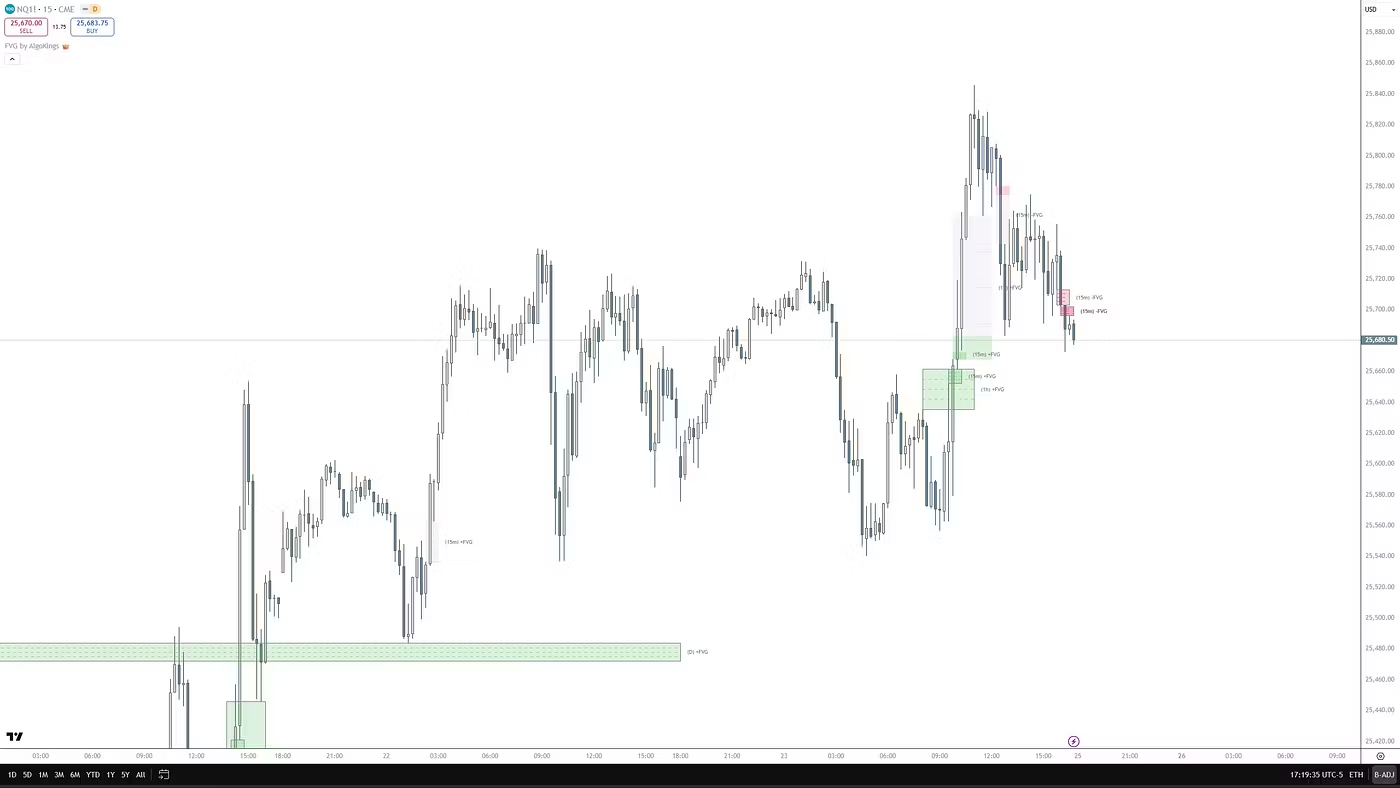
A fair value gap is the untouched price range left behind when the market moves so quickly in one direction that it skips a level, leaving an imbalance where little two-sided trading occurred. It is read across three candles: candle 1, a large displacement candle 2, and candle 3. For a bullish FVG, the gap is the space between the high of candle 1 and the low of candle 3 after a strong up-move. For a bearish FVG, it is the space between the low of candle 1 and the high of candle 3 after a strong down-move. Draw the boundaries from the wicks of candles 1 and 3 — not the bodies — or your zone will be wrong. The popular idea from ICT and Smart Money Concepts is that price often returns to 'rebalance' this inefficiency, which is why traders watch unmitigated gaps as potential reaction areas.
How to trade a fair value gap, step by step
- 1) Establish higher-timeframe bias. Read trend and structure on a higher timeframe first; only look for longs in an uptrend and shorts in a downtrend unless you have a confirmed change of character.
- 2) Find premium vs. discount. In an uptrend, favour bullish FVGs sitting in the discount (lower) half of the range; in a downtrend, favour bearish FVGs in the premium (upper) half.
- 3) Locate a fresh, unmitigated gap. Mark a recent FVG that price has not yet traded back into. Skip gaps formed inside choppy consolidation — they carry little predictive value.
- 4) Wait for the retrace. Let price pull back into the gap instead of chasing the impulse. Patience here is most of the edge.
- 5) Confirm with price action. Look for a rejection wick, an engulfing candle, or a lower-timeframe break of structure (BOS) or change of character (CHoCH) before committing.
- 6) Enter. Aggressive traders use a limit order at the gap edge or its 50% level; conservative traders wait for the lower-timeframe confirmation above.
- 7) Set stop and target. Place the stop just beyond the far edge of the gap (not inside it) and target the next liquidity or structure level, aiming for at least a 1:2 reward-to-risk.
Mitigation, the 50% level, and the inverse FVG
A gap is 'mitigated' or 'filled' once price trades back through it and rebalances the imbalance. Traders distinguish a full fill, a partial fill, and the 50% midpoint — often called consequent encroachment — which some use as a precise entry reference. Once a gap is fully filled, its original edge is largely gone, so trading an already-mitigated FVG is usually a mistake. There is also the inverse fair value gap (IFVG): when price breaks decisively through a gap, that level can flip roles and act as resistance or support in the opposite direction. Note that an FVG is not the same as a regular opening or news gap, and it differs from a broad liquidity void — they describe different things even though all involve 'gaps'.
Common mistakes and realistic expectations
- Assuming every gap fills — many stay partially or fully unfilled, so a fill is a probability, never a guarantee.
- Trading every gap you see — the market prints FVGs constantly and most are noise; only fresh gaps with trend and structure alignment are worth watching.
- Entering the instant price touches the gap with no rejection or confirmation, then getting run over when price slices straight through.
- Ignoring premium/discount context — buying a bullish FVG sitting in premium, or fading the dominant trend without a confirmed CHoCH.
- Placing the stop inside the gap, so normal rebalancing wobble stops you out before the move develops.
- Relying on an indicator blindly without higher-timeframe context, and trading through high-impact news when structure breaks down.
- Skipping backtesting and treating FVGs as a standalone system rather than one confluence inside a risk-managed plan.
Frequently asked questions
How do you identify a fair value gap on a chart?
Look for three consecutive candles where the middle one is a large displacement candle, then check whether the wicks of candle 1 and candle 3 fail to overlap. A bullish FVG is the empty space between candle 1's high and candle 3's low; a bearish FVG is the space between candle 1's low and candle 3's high. Always measure from the wicks, not the bodies.
Where do you place your stop loss and take profit when trading an FVG?
A common approach is a stop just beyond the far edge of the gap — below a bullish gap or above a bearish gap, never inside it — and a take profit at the next clear liquidity or structure level, aiming for at least a 1:2 reward-to-risk. These are general risk-management conventions for analysis, not financial advice, and you should size positions according to your own plan.
How reliable are fair value gaps and what win rate can I expect?
There is no fixed or guaranteed win rate. FVGs are probabilistic zones, and many gaps stay partially or fully unfilled. Their usefulness comes from confluence — trend alignment, premium/discount, structure, and confirmation — combined with disciplined risk management. Backtest any approach on your own markets and timeframes before risking capital.
Risk disclosure
AlgoKings provides technical analysis indicators and educational material for informational purposes only. Nothing on this website is financial, investment or trading advice. Trading financial instruments carries a high level of risk and may not be suitable for every investor; you can lose some or all of your capital. Indicators do not predict future price movements and do not guarantee any outcome. You are solely responsible for your own trading decisions and risk management. Past performance is not indicative of future results.