Smart Money Concepts vs ICT: What's the Difference?
No, SMC and ICT are not the same thing, but they are not rivals either. The difference between SMC and ICT is mostly one of source and scope: ICT (Inner Circle Trader) is a specific, branded methodology taught by one person, Michael J. Huddleston, while Smart Money Concepts (SMC) is the broader, community-developed term for institutional price-action trading that grew largely out of ICT's material. Put simply, in the SMC vs ICT comparison, ICT is mostly the source and SMC is the streamlined, genericized descendant, and the two share most of the same toolkit.
The short answer
If you only remember one line, make it this: all ICT is a form of smart-money trading, but not all SMC is ICT. ICT is the original branded framework taught by Michael J. Huddleston (screen name 'The Inner Circle Trader'). SMC is the popularized, generalized version the wider retail community built on top of it through YouTube, forums, and courses. They are not opposites and they are not identical. SMC essentially packages a simplified subset of ICT's ideas, plus the same shared vocabulary of liquidity, order blocks, and structure.
Because the overlap is so large, framing 'SMC vs ICT' as rival camps is mostly a debate about branding and depth. Understanding the shared concepts matters more than picking a side.
Defining the terms precisely
Smart money (the old idea)
'Smart money' is a long-standing market term for large, well-capitalized institutional participants such as banks and funds, as opposed to retail traders (sometimes called 'dumb money'). The idea of reading institutional footprints in price traces back to Richard Wyckoff in the early 1900s, long before ICT existed. Modern SMC is, in effect, a recent iteration of a century-old concept.
Smart Money Concepts (SMC)
SMC is a modern price-action framework built on the premise that institutions move price by engineering liquidity and leaving structural footprints: order blocks, fair value gaps, liquidity sweeps, and breaks of structure. It is community-developed and has no single owner.
ICT (Inner Circle Trader)
ICT is Huddleston's specific, comprehensive methodology, taught primarily through free YouTube content. It includes the same SMC building blocks plus extra layers: time-based windows (kill zones), an algorithmic market-maker narrative, and named setups such as the Power of Three, the Judas Swing, and the Silver Bullet.
Where SMC and ICT actually differ
Most of the individual tools are shared, often under different names. The real dividing line is time and complexity. ICT's signature addition over generic SMC is its focus on when institutional activity is most likely active. SMC, by contrast, is largely time-agnostic and concentrates on the structural price patterns themselves.
- Shared by both (often different names): order blocks, fair value gaps (also called imbalances or inefficiencies), liquidity pools and sweeps, break of structure (BOS), change of character (CHoCH).
- More ICT-flavored: market structure shift (MSS), and premium/discount zones with the Optimal Trade Entry (OTE) Fibonacci band (roughly the 62-79% retracement, centered on 70.5%).
- ICT only: kill zones (session windows such as London and New York), the Power of Three (accumulation-manipulation-distribution), the Judas Swing, the Silver Bullet, specific market-maker models, and the heavy time-and-price narrative.
- Practical feel: SMC is usually the more visual, streamlined, beginner-friendly entry point; ICT is broader, deeper, and widely described as overwhelming.
A concrete example: both an SMC trader and an ICT trader might mark the same down-candle before a sharp rally as a bullish order block and watch for price to return to it. The ICT trader will additionally ask whether price reaches that order block inside the New York kill zone and whether the move fits a Power-of-Three accumulation-manipulation-distribution sequence. Same zone on the chart; an extra layer of timing on top.
Which should you learn first?
Many educators suggest a common path: start with SMC to learn structure, order blocks, fair value gaps, and liquidity, because it is simpler and more visual. Then, as you progress, layer in ICT's time-and-price elements such as kill zones and OTE. Expect a long runway either way. ICT's full curriculum is large and can take months to work through, and even committed students often report a year or more before any consistency. None of that timeline is a guarantee of profitability.
An honest word on what these frameworks are (and are not)
Both SMC and ICT are interpretive analytical frameworks, not a live feed of institutional orders. Retail traders cannot see what banks are actually doing; they infer it from price. Any claim that these methods let you 'see exactly what smart money is doing' overstates the case. There is also no robust, independent published evidence that either approach is systematically profitable. ICT's founder has been widely criticized for never publicly verifying a profitable track record, and two public attempts often cited by critics, a 2016 account challenge and the 2024 Robbins Cup contest, reportedly ended in failure. Treat both frameworks as ways to organize how you read a chart, not as a money-printing system.
- Subjectivity is real: identifying 'the' order block or a valid fair value gap involves discretion, so two traders can mark the same chart differently.
- Overcomplication is a common failure mode, especially with ICT: people can recite theory but struggle to execute. Less is usually more.
- Risk management is under-taught: both bodies of material lean heavily on analysis and lightly on position sizing and risk, which you have to supply yourself.
- Much of it has older roots: order blocks, imbalances, and liquidity are largely reframed Wyckoff, supply-and-demand, and support-resistance ideas, so the novelty is often overstated.
Where tools fit in
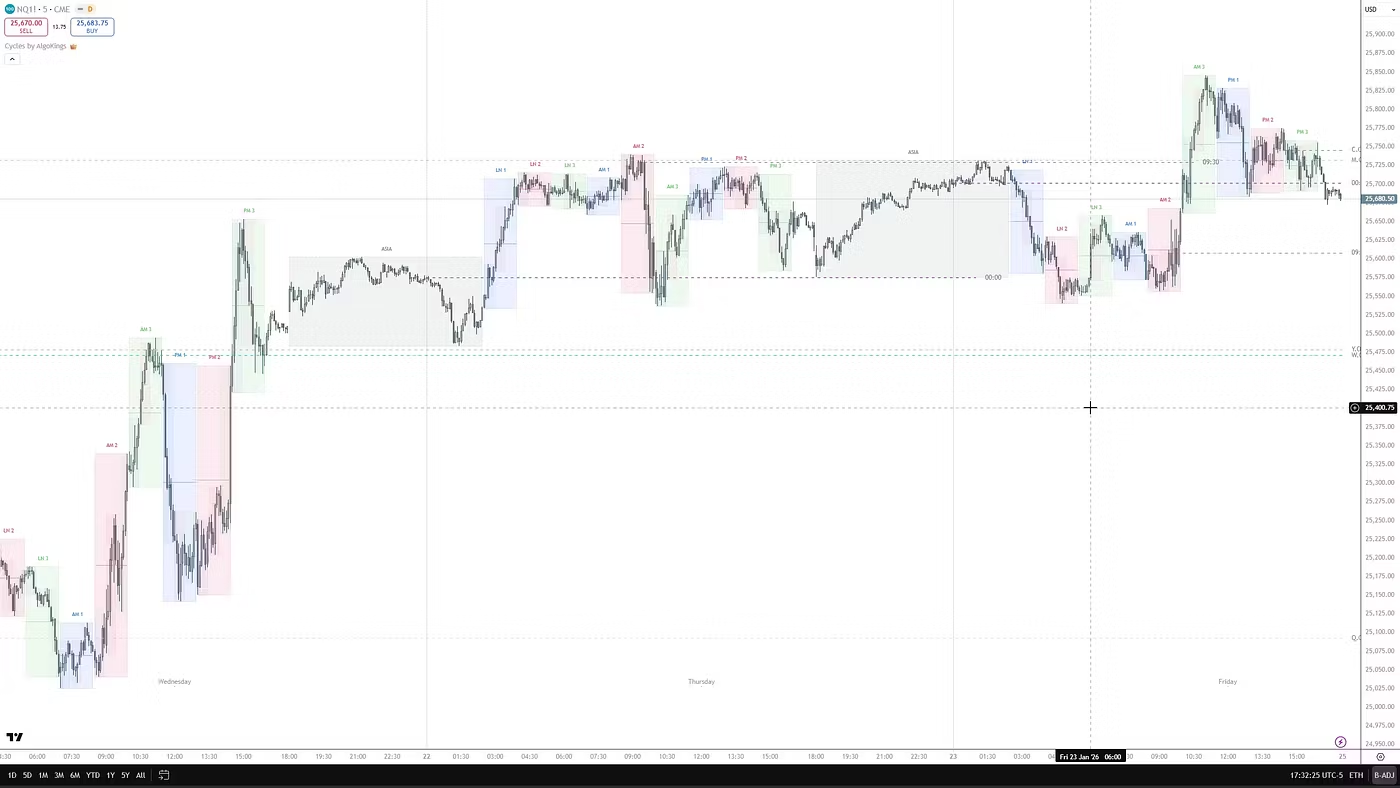
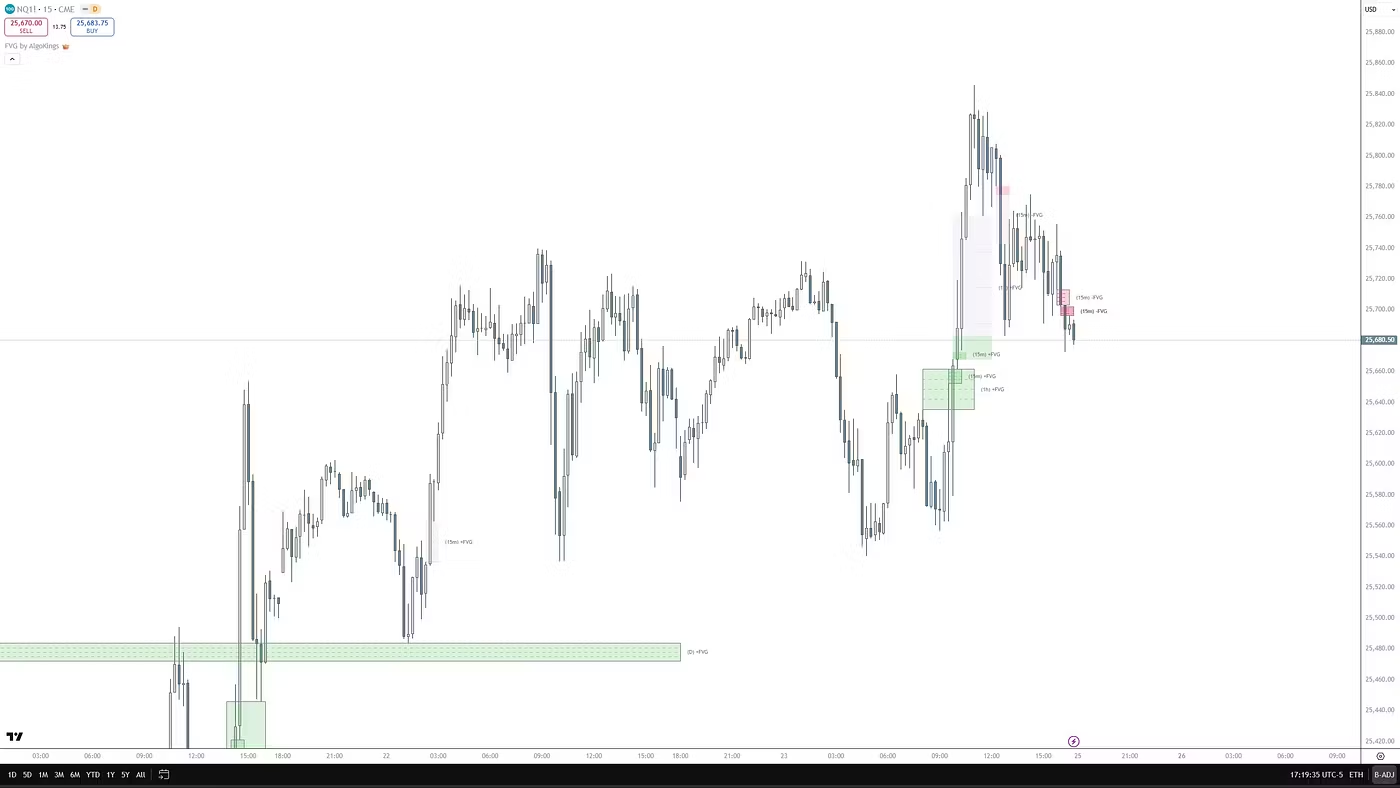
Both SMC and ICT are 'naked chart' price-action approaches, so piling on unrelated indicators tends to work against the method. Where a charting tool genuinely helps is in automating the repetitive marking: highlighting breaks of structure and changes of character, drawing fair value gaps, flagging order blocks, and, for ICT-style work, shading kill-zone times. That saves charting time. It does not reveal hidden bank activity, and it cannot tell you whether a setup will work. AlgoKings' SMC Package and standalone FVG tool, for example, mark this structure on TradingView so you spend less time drawing and more time deciding, while the analysis and risk decisions stay with you.
Frequently asked questions
Is SMC the same as ICT?
No. ICT (Inner Circle Trader) is the original branded methodology taught by Michael J. Huddleston, while SMC (Smart Money Concepts) is the broader community version that grew largely out of ICT's teachings. They share most of the same toolkit, so they are closely related but not identical, and not opposites.
What is the actual difference between SMC and ICT?
The main difference is timing and complexity. ICT adds time-based layers such as kill zones, plus an algorithmic market-maker narrative and named setups like the Power of Three and the Silver Bullet, and it is significantly more involved. SMC is a streamlined, largely time-agnostic focus on structural price action: order blocks, fair value gaps, liquidity, and breaks of structure.
Should I learn SMC or ICT first as a beginner?
Many educators suggest learning SMC first because it is simpler and more visual: structure, order blocks, fair value gaps, and liquidity. Once those feel natural, you can layer in ICT's time-and-price elements such as kill zones and Optimal Trade Entry. Expect a long learning curve either way, and remember that time invested is not a guarantee of profit.
Did Michael Huddleston (ICT) invent Smart Money Concepts?
Not exactly. He systematized and popularized the modern framework that most of today's SMC content is derived from, but the underlying 'smart money' idea is much older and traces back to Richard Wyckoff in the early 1900s. Many ICT concepts are themselves reframed from Wyckoff, supply-and-demand, and classic support-resistance, so it is fairer to say he popularized rather than invented the idea.
Can you combine ICT and SMC?
Yes, and many traders do. The two are complementary rather than mutually exclusive. A common hybrid is to use SMC market structure and zones to define the setup, then apply ICT timing (such as kill zones) and Optimal Trade Entry to refine when to act.
Does SMC or ICT actually work? Is it profitable?
There are no guarantees and no robust independent evidence that either method is systematically profitable. Both are interpretive frameworks for reading price, not a feed of real institutional orders and not trading signals. Results depend heavily on execution, discretion, and risk management, which the material itself tends to under-teach. Treat any profit claim with skepticism. This is educational information, not financial advice.
Risk disclosure
AlgoKings provides technical analysis indicators and educational material for informational purposes only. Nothing on this website is financial, investment or trading advice. Trading financial instruments carries a high level of risk and may not be suitable for every investor; you can lose some or all of your capital. Indicators do not predict future price movements and do not guarantee any outcome. You are solely responsible for your own trading decisions and risk management. Past performance is not indicative of future results.