Displacement in Trading Explained
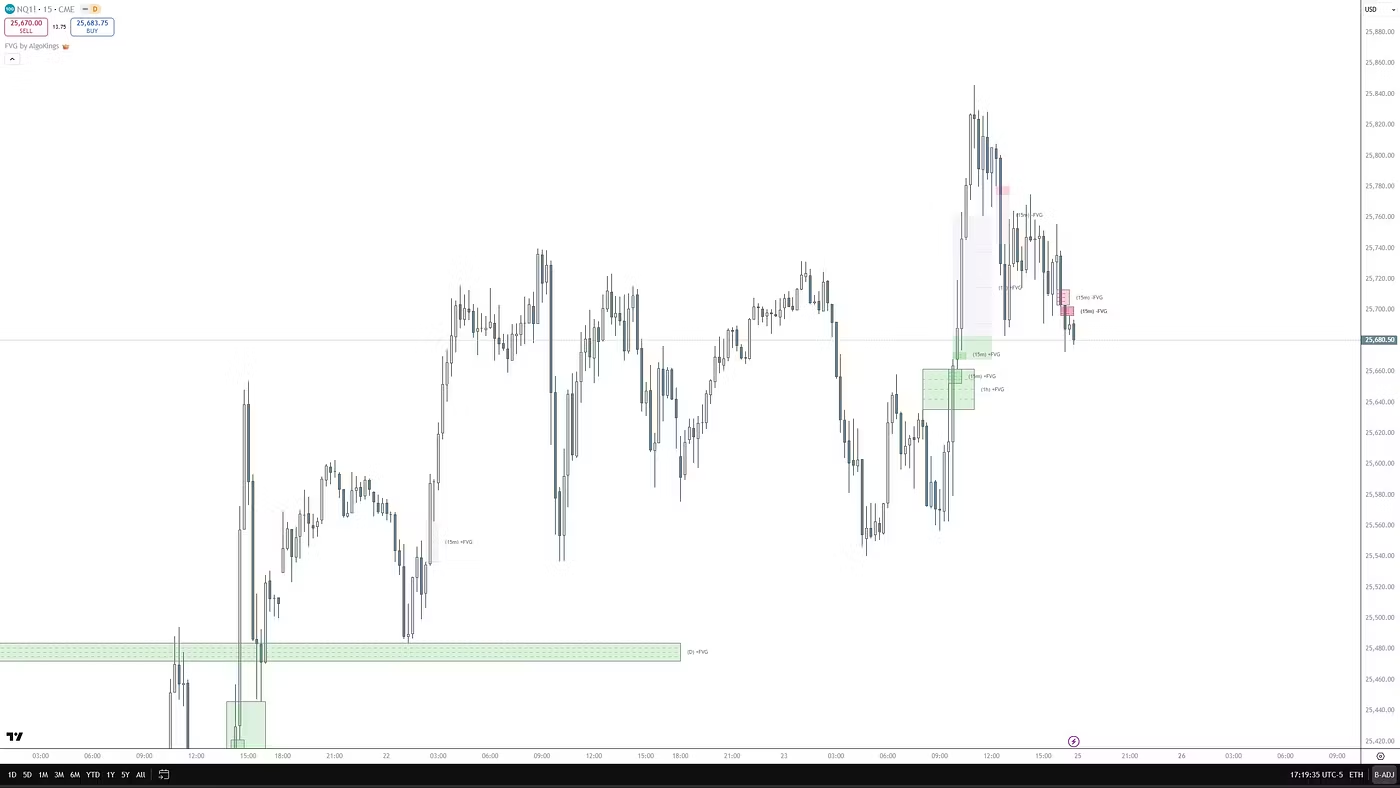
In ICT (Inner Circle Trader) methodology, displacement is a sharp, one-directional price move that signals aggressive institutional participation as price is repriced from one level to another. It typically shows as one or more strong, large-bodied candles with little to no wick that leave behind a Fair Value Gap (FVG) and usually break market structure.
What displacement actually means
Displacement describes a deliberate, momentum-driven repricing of an asset, not random volatility. In Smart Money Concepts (SMC) and ICT theory, it marks the moment large participants transact heavily enough to push price quickly from one area to another. The key idea is intent: a displacement move reflects one-sided commitment, which is why traders study it as a clue to directional bias rather than as a standalone trigger to act on.
How to identify displacement
The visual 'fingerprint' is what separates displacement from an ordinary fast move. Look for the following characteristics together, not in isolation:
- One or more strong, large-bodied candles moving the same direction, large relative to recent price action.
- Small or minimal wicks, showing little hesitation or two-way trading during the move.
- An obvious imbalance left behind in the form of a Fair Value Gap (FVG).
- A break of market structure, either continuing the trend (BOS) or shifting it (MSS).
- Often a liquidity sweep, where prior highs or lows are run, immediately before the expansion.
Because displacement is relative to the timeframe, there is no fixed pip or point size that qualifies. A 'large' candle on a 5-minute chart is tiny next to a daily one. Judge the move against its own timeframe and against recent candles, not against an absolute threshold.
Displacement, FVGs, and market structure
When price moves fast, the market often skips levels, leaving a three-candle imbalance known as a Fair Value Gap. This is why displacement and FVGs are so closely linked: the speed of the move is what creates the inefficiency. ICT traders treat that FVG, together with the originating order block (the last opposing candle before the move), as a zone to watch if price later retraces into it. Structurally, a displacement that breaks a prior swing in the trend direction is a Break of Structure (BOS, continuation), while one that breaks structure against the prevailing trend is a Market Structure Shift (MSS, potential reversal). For bullish displacement the FVG typically sits below price; for bearish displacement it sits above.
How traders use it (with risk in mind)
Displacement is a confirmation and bias tool, not a complete strategy. A common ICT framework studies it in sequence: confirm higher-timeframe structure and whether price sits in a premium or discount zone, wait for a liquidity sweep, identify the displacement and its FVG, then wait for a retracement back into that FVG or order block, often looking for a lower-timeframe MSS as added confirmation. Risk is defined relative to the displacement extreme: the idea is invalidated if the gap fully fills or structure breaks back the other way. Price does not always continue in the displacement direction; whether it continues or reverses depends on the broader structure, so entering immediately on the displacement candle itself tends to mean chasing and poor risk-reward. None of this guarantees an outcome, and position sizing and stop placement remain essential.
Frequently asked questions
Does displacement always create a Fair Value Gap?
Most genuine displacement moves leave an FVG because the speed of the move skips price levels and creates an imbalance. If a fast move leaves no FVG and no clear break of structure, it is better treated as ordinary momentum or noise rather than institutional displacement.
Is every big or fast candle a displacement?
No. A single large candle, a news spike, or a brief stop run can look dramatic without being displacement. Genuine displacement shows the full fingerprint together: a strong, large-bodied move with small wicks, an accompanying FVG, and a structure break. Without those objective criteria you risk forcing the pattern where it does not exist.
What is the difference between a BOS and an MSS caused by displacement?
A Break of Structure (BOS) happens when displacement breaks a swing point in the direction of the existing trend, suggesting continuation. A Market Structure Shift (MSS) happens when displacement breaks structure against the prevailing trend, signalling a possible reversal. Both involve displacement; the difference is the direction relative to the current trend.
Risk disclosure
AlgoKings provides technical analysis indicators and educational material for informational purposes only. Nothing on this website is financial, investment or trading advice. Trading financial instruments carries a high level of risk and may not be suitable for every investor; you can lose some or all of your capital. Indicators do not predict future price movements and do not guarantee any outcome. You are solely responsible for your own trading decisions and risk management. Past performance is not indicative of future results.